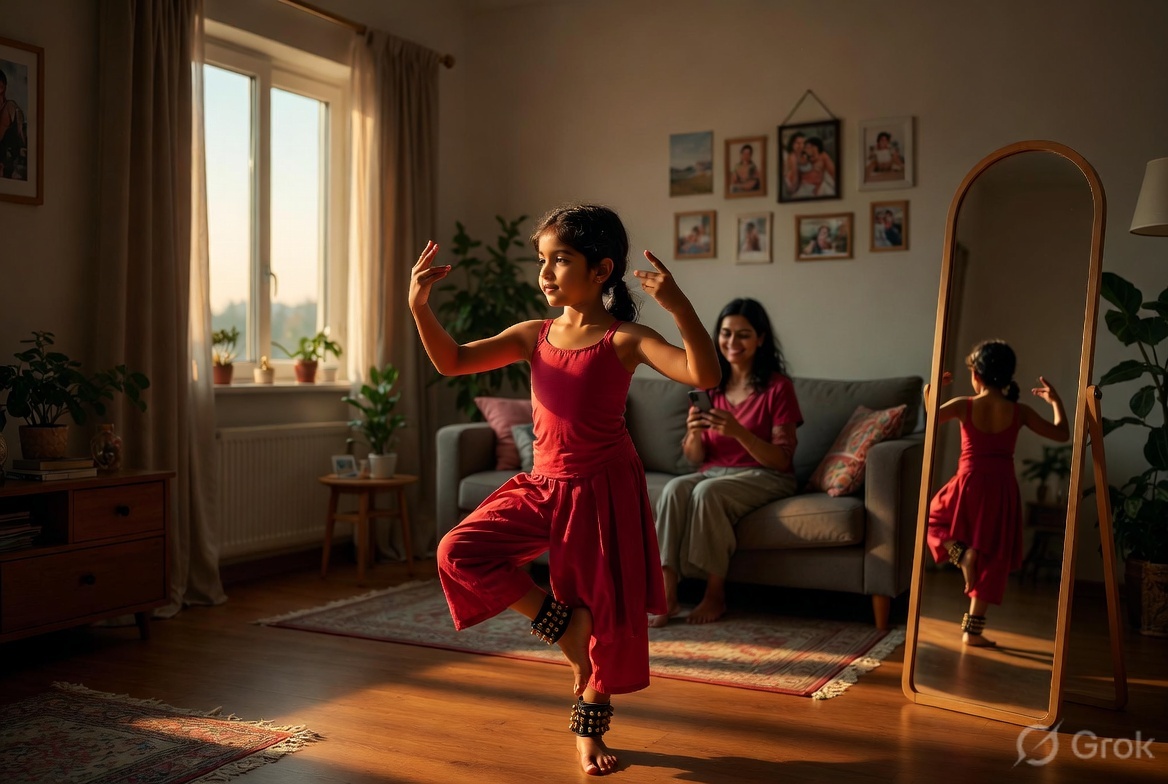
How Much Practice Does a Beginner Need Each Week? A Smart Guide for Bharatanatyam Students
Great results come not from dramatic effort, but from small disciplined steps repeated over time.
One of the first questions parents and new students ask is simple: how much practice is enough?
Too little, and progress slows. Too much too soon, and beginners can lose interest, energy, or joy. The good news: Bharatanatyam does not require endless hours in the beginning. What it needs most is consistency, correct guidance, and joyful repetition.
For beginners, a small weekly system matters far more than heroic bursts of effort. Let’s look at what works realistically.
The golden rule: short and regular beats long and rare
Many families assume one long weekend session is enough. Usually, it is not. In movement-based learning, the body remembers through repetition. Frequent short sessions help posture, rhythm, coordination, and memory improve steadily.
20 minutes · 4 times a week
2 hours · once a week
The body learns better through regular reminders than occasional overload.
Ideal practice time, by age
10–15 min · 3–4× / week
Keep it playful and light. Focus on movement, rhythm, balance, and enjoyment.
20–30 min · 4× / week
A strong stage for building adavus, posture, stamina, and routine.
30–45 min · 4–5× / week
Older students can usually handle more focused repetition and technique work.
30 min · 3–5× / week
Consistency matters more than intensity for adult beginners.
What should a beginner actually practise?
Not every session needs to be intense. A balanced beginner session can fit into roughly 30 minutes:
A balanced 30-minute beginner session
Even a short, well-structured session can be highly effective.
Quality matters more than quantity
Thirty minutes of distracted practice is weaker than fifteen minutes of focused practice. Encourage beginners to practise:
- With correct posture — even at the cost of speed
- Without rushing through steps
- Watching mirror alignment when possible
- Listening carefully to teacher instructions
- Repeating the basics with care, not boredom
How to know your child is practising the right amount
- Better balance and posture
- Improved memory of steps
- Growing confidence
- Increased stamina
- Looking forward to class
- Frequent resistance before practice
- Soreness without recovery
- Stress or dread before class
- Boredom from over-repetition
- Signs of burnout
If joy disappears, the schedule may need adjusting.
A common mistake: some parents become anxious watching another child progress faster, and respond by piling on more practice hours. That often backfires. Every child develops differently — comparing practice hours can quietly damage motivation. Author Alfie Kohn, known for his work on parenting and education, has long argued that children grow best when supported rather than controlled.
A simple, sustainable weekly plan
Instead of demanding perfection, build rhythm. A working example for a school-age beginner:
Simple. Sustainable. Effective.
What if the child is very busy?
School exams, travel, and other activities are real. During busy weeks, even 10 minutes of revision, watching a lesson video, clapping rhythm, or gentle stretching can preserve momentum. Some practice is always better than none.
The final takeaway
How much practice does a beginner need each week? Usually 3 to 5 short sessions, depending on age and energy, is enough to build meaningful progress.
You do not need to overwhelm a beginner. You need consistency, encouragement, and steady repetition.
In Bharatanatyam — as in life — great results are created not by dramatic effort, but by small disciplined steps repeated over time.