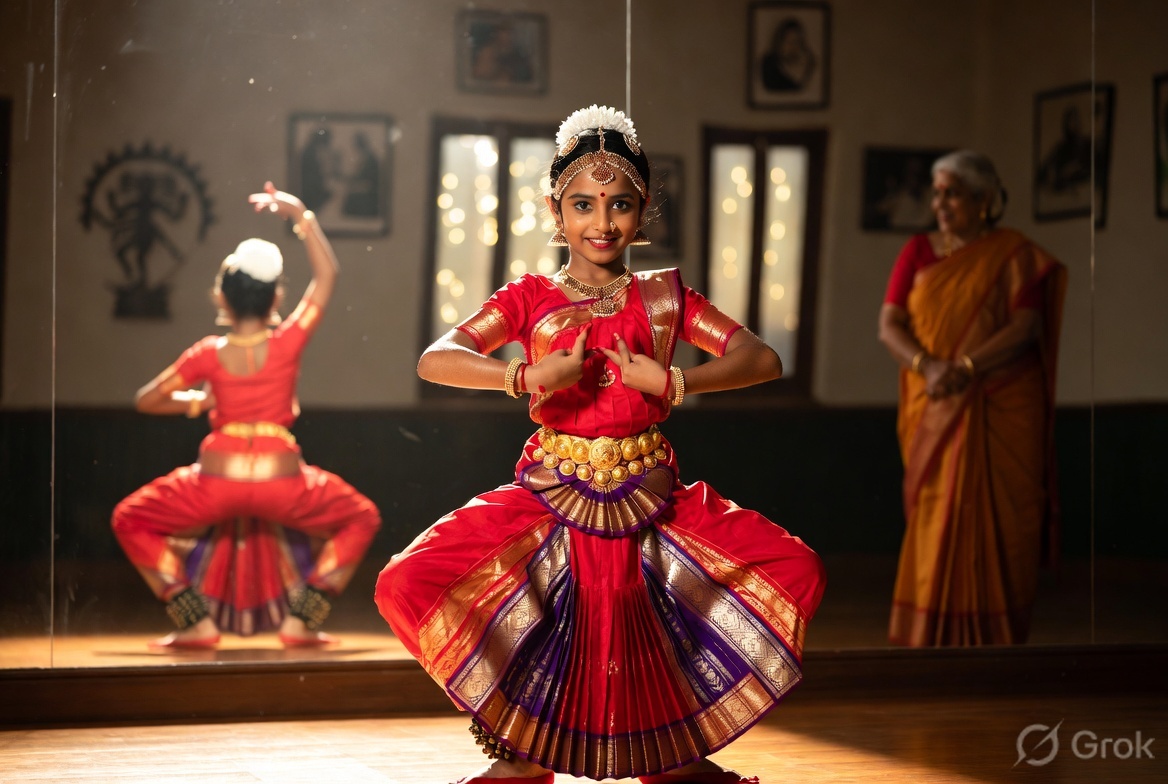
How Bharatanatyam Builds Discipline, Focus & Confidence in Children
A practice-by-practice look at how a classical art quietly shapes character.
In a world filled with distractions, instant gratification, and shrinking attention spans, many parents are searching for activities that do more than just “keep children busy”. They want something that shapes character.
That is where Bharatanatyam stands apart. Far beyond dance, it is a time-tested training of the body, mind, and spirit. For generations, families have turned to classical arts not only for performance skills, but for life skills.
Bharatanatyam helps children build those habits early. Here is how it develops three priceless qualities — discipline, focus, and confidence — and three more that quietly travel with them.
01 Discipline through practice and routine
Every Bharatanatyam student learns an important truth quickly: progress comes through repetition.
Basic adavus (foundational steps), posture, rhythm, hand gestures, and coordination all require regular practice. Children discover that improvement is earned — not downloaded instantly. The mindset travels:
- Time management
- Patience with slow progress
- Respect for routine
- Commitment to long-term goals
02 Focus, in an age of distraction
Modern childhood competes with screens, notifications, and endless stimulation. Bharatanatyam asks children to do the opposite:
- Listen carefully
- Watch attentively
- Remember sequences
- Follow rhythm cycles (tala)
- Coordinate hands, feet, eyes, and expression — all at once
This naturally trains concentration. Research on arts education has consistently shown that music and movement-based learning support memory, attention span, and cognitive flexibility. In simple words: dance trains the brain while training the body. 🧠
03 Confidence, built one performance at a time
Confidence rarely appears magically. It is built through experience.
When children first enter class, many are shy, hesitant, or unsure of their bodies. But over time they learn steps, improve posture, perform in front of peers, and eventually step onto a stage. That journey transforms them. A child who once hid behind a parent may, one day, stand before hundreds with poise.
Why stage experience matters
Public performance quietly builds:
- Speaking comfortably in front of others
- Handling nervousness without shutting down
- Recovering gracefully from mistakes
- Carrying themselves with presence
These skills travel into school presentations, college interviews, leadership roles, and social situations many years later.
04 Respect for teachers and process
Classical arts are deeply rooted in the teacher–student tradition. Children learn to accept correction gracefully, show gratitude, value guidance, and respect effort and mastery. These qualities are increasingly rare — and increasingly valuable.
Bharatanatyam teaches children to walk that bridge with humility, one class at a time.
05 Emotional confidence through expression
Bharatanatyam is not only physical technique. It includes abhinaya — the art of expression. Children learn to portray joy, courage, devotion, humour, sadness, and wonder through face and gesture. That builds emotional intelligence:
- Understanding feelings
- Communicating without words
- Becoming comfortable being seen
- Developing empathy through storytelling
Children who can express themselves freely often become more secure in who they are.
06 The hidden benefit: grace under pressure
No performance is perfect. Sometimes steps are forgotten. Music timing shifts. Nerves arrive uninvited. Yet students learn to continue, recover, smile, and finish with dignity. That resilience may be one of the greatest lessons of all.
Because later in life — exams, careers, relationships, setbacks — the same ability is what carries us through.
What parents can do to maximise these benefits
Growth happens best with encouragement, not pressure. A few practical things help:
- Prioritise consistency over perfection
- Praise effort, not only performance
- Allow protected time for practice at home
- Attend recitals and celebrate progress, however small
- Choose a teacher who balances warmth and discipline
Children thrive when the art feels meaningful — not stressful. ✨
A real-world truth
Many parents enrol children hoping they will “learn dance”. Years later, the same parents often say the bigger reward was something else entirely — seeing their child become calmer, more confident, more responsible. The dance was visible. The character growth was deeper.
The final takeaway
How does Bharatanatyam build discipline, focus, and confidence in children? Through repeated practice, attentive learning, expressive growth, and the courage to perform.
It teaches children that mastery takes patience, attention creates excellence, and confidence is earned step by step.
In a fast world chasing shortcuts, Bharatanatyam offers something timeless: the slow, beautiful making of a strong child.