Common Mistakes Parents Make in Classical Dance Training
Usually not lack of love — but misplaced urgency.
When a child begins classical dance training, parents step into the journey with excitement, hope, and the best intentions. They imagine confidence on stage, graceful posture, cultural connection, discipline, and growth.
Many of those benefits are real. But sometimes, without realising it, parents make small mistakes that create pressure where there should be joy — and stress where there should be steady progress. The truth is simple: a child’s dance journey is shaped as much by the home environment as by the classroom.
Children often experience an art through the mindset adults bring to it. Here are nine common mistakes parents make — and how to gently avoid them.
01 Chasing fast results
Many parents want visible progress quickly — stage performances, advanced items, costumes, certificates, social-media-worthy moments. But classical dance is built on fundamentals: posture, rhythm, coordination, discipline, repetition. Rushing the foundation weakens the future structure.
Respect slow growth. Strong basics create lasting excellence.
02 Comparing their child to others
This is one of the most damaging habits. “Look how well she dances.” “He learned faster.” “They already moved to the next level.” Every child learns differently. Some develop rhythm early; others gain confidence later; some blossom only after months of quiet observation. Comparison creates insecurity more often than motivation.
Compare your child only to who they were six months ago.
03 Turning practice into pressure
Encouragement helps. Constant monitoring does not. Children can begin to associate dance with tension when every session becomes corrections from parents, criticism after class, forced repetition, or emotional pressure to perform well. What starts as art becomes obligation.
Create a calm practice routine. Let the teacher teach. Let home remain supportive.
04 Focusing only on performances
Some parents evaluate progress only by visible milestones — how many shows, how many medals, how many costumes. But some of the deepest growth is invisible:
- Better focus
- Improved discipline
- Quiet confidence
- Posture and patience
- Emotional maturity
These qualities matter long after the applause ends.
05 Ignoring the child’s personality
Not every child is loud, expressive, or stage-ready immediately. Some are thoughtful, shy, and slower to warm up — and that does not mean they are less capable. Many quiet children become extraordinary artists over time.
Support your child’s natural pace while encouraging gentle growth.
06 Choosing convenience over teaching quality
Nearest class. Cheapest fee. Quickest option. Convenience matters — but teacher quality matters more. A strong teacher shapes technique, mindset, and confidence for years.
Choose mentorship over proximity whenever reasonably possible.
07 Overloading the child
Dance plus school plus tuition plus sports plus music plus endless schedules can exhaust even the most willing student. When rest disappears, even talented children struggle. Burnout often looks like laziness — but is really overload.
Protect sleep, free play, family time, and recovery. A rested child grows; an exhausted one shrinks.
08 Criticising right after a performance
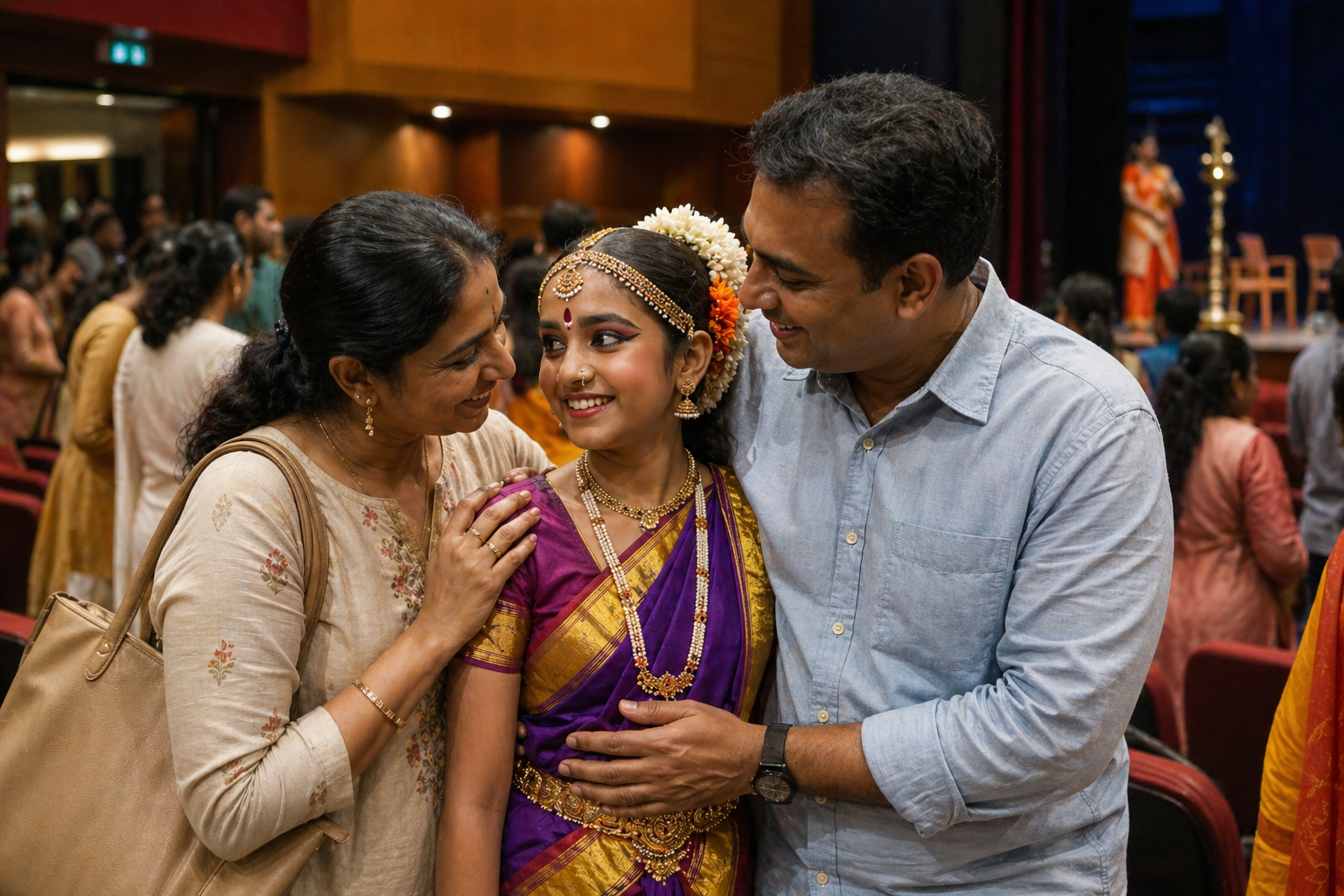
Many children step off stage excited — only to hear, “You forgot that step” or “Why weren’t you smiling?” or “Others were better.” That moment matters deeply. Children need celebration before correction.
First say, “We are proud of your courage.” Feedback can come later — and gently.
09 Undervaluing consistency
Some parents expect progress without regular attendance or home practice. Classical arts reward rhythm and repetition. One missed week is normal; chronic inconsistency slows everything quietly.
Choose a realistic schedule you can actually sustain — the one you keep is the one that works.
What great parent support looks like ✨
The most helpful dance parents tend to:
- Encourage without controlling
- Praise effort, not only results
- Trust the teacher
- Stay patient with progress
- Protect joy in learning
- Celebrate courage and discipline
The final takeaway
What are the common mistakes parents make in classical dance training? Usually not lack of love — but misplaced urgency.
When parents replace comparison with patience, pressure with encouragement, and speed with trust, children thrive.
Because the goal of classical dance is not only to create performers. It is to help shape graceful, disciplined, resilient human beings.